
Developing our first round of prototypes and putting their usability to the test
Following on from our co-design workshops, we built the first set of prototypes that would become the core of the Smart Cues project.
Beyond Passive Monitoring
Prior to building the prototypes, we wanted to examine the current approaches to home-based physical activity as seen in the wider literature. To support our understanding, we conducted a literature review of 21 papers published since 2015 looking at how they worked and what techniques they used to try and encourage physical activity. This review considered the types of devices, the sensors used, the methods of feedback deployed and the Behaviour Change Techniques (BCTs) present within these devices.
This review identified a number of interesting trends:
• Home Constraints – The design of home-based activity systems displayed clear trends towards strength and balance exercises. The two key factors that seemed to play into this were the focus on older adults in the home environment who would not as easily engage with aerobic exercises, but also in the need to fit into the domestic environment. Their lightweight, low-footprint design often better served strength and balance exercises, but aerobic exercises in the home would also benefit user health.
• Layered Cues Living in Objects – Physical form and placement influence user behaviours. The device does not need to shoulder the full burden of promoting activity as it can use existing routines within the environment to reduce extra interface work linking cues with behaviours. Layering cues for activity within the lived environment, and combining these with existing routines, could help promote greater sustainable activity.
• Household Ecologies – There was a noticeable misalignment between the single-device nature of many systems and the multi-room nature of many homes. In combination with the piggybacking of existing routines, a modular multi-device set-up could help to support activity throughout the home environment, and help build habits regardless of where the user may be positioned within their own home.
Read more about this review here.
Prototypes Development
We developed our prototypes based on the combined feedback of the workshops and the literature review (see Stage 1). The workshops mainly informed the exercises and the individual considerations for design, while the review informed the greater design of the intervention devices. As part of the initial workshops, we identified a set of simple exercises that people could engage with as part of their daily routine: Sit-to-stand, One Leg Stand, Wall Sit, Arm Extensions (realised as an NFC game), March, and Arm Cross & Hold. A Pose Challenge was introduced to replace Arm Cross & Hold, resolving a common complaint that the exercise felt aimless.
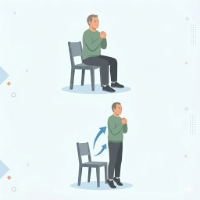
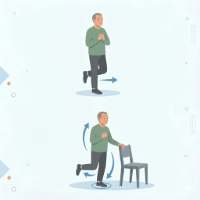
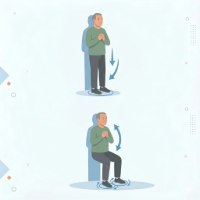
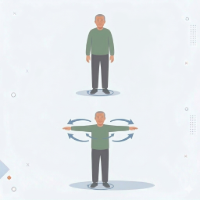
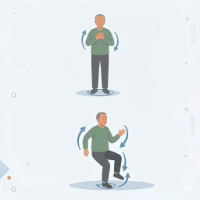
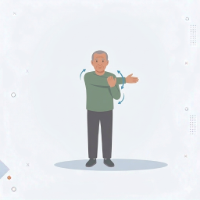
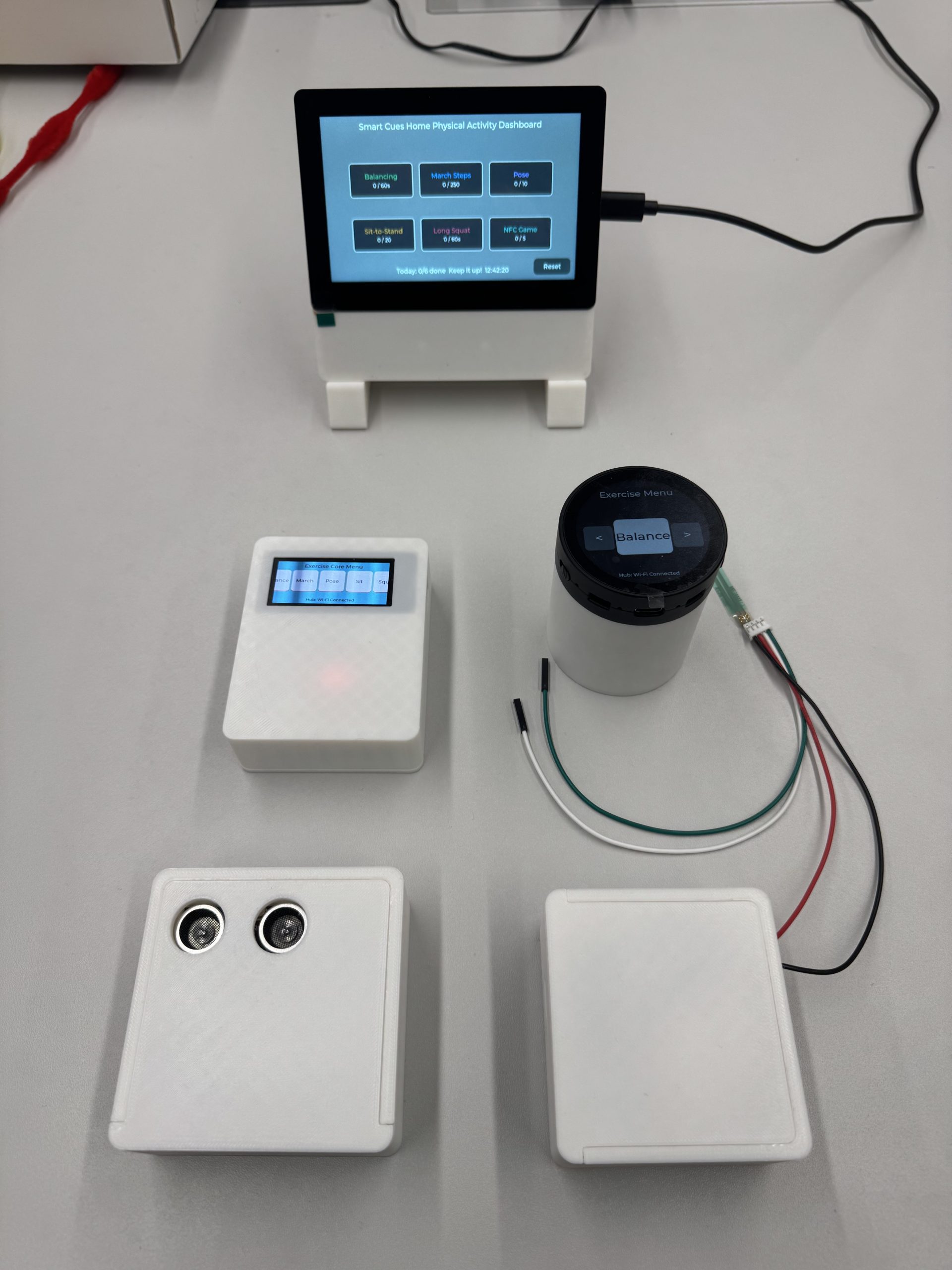
Starting from the five individual exercise prototypes from Workshops 4-6, we first removed any redundancy by identifying exercises that used similar (or even the same) sensors and feedback modalities and could therefore function as a single device. March Steps, Balance and Pose Challenge all used motion detection in a handheld device, and the NFC game used a small sensor that could be embedded in a similar handheld device. The other exercises, Sit-to-stand and Squat, required situated sensors and therefore were not viable in handheld form. As such, the devices were built as a handheld unit that facilitated March, Bounce, Pose and NFC, and connected with two external modules to facilitate Squat and Sit to Stand. We also developed two forms of the handheld unit, one rectangular and one cylindrical, due to concerns of how easy the rectangular unit would be to hold for those with lesser motor control.
Usability Testing and Iteration
These devices were taken forward into usability testing, where we asked 8 participants (potential end users) to complete the set of exercises and communicate any frictions or issues encountered. Each usability session started with a short interview asking about their experiences with exercise, especially at home, and exercise technology. We then presented a series of tasks such as turning on the system, setting personal goals and completing the exercises. Following this, we asked further questions about the usability and more general feedback.
Users generally found the system enjoyable to use and felt that most of the exercises were easy to understand and easy to complete. During the presented tasks, we identified exercises that caused issues for our users:
1. The pose challenge was seen to be hard to understand. The approach our device used was to suggest a pose, which the user would then have five seconds to match, and the device would either move on to the next exercise or ask them to repeat if the pose was deemed to be incorrect. However, the ‘correctness’ was based on the direction of the device, and users often tried to check the screen which would invalidate the pose.
2. Users experienced some confusion into how the floor-based squat sensor worked. Some users would squat over the sensor (the intended use), whereas others would squat with the handheld unit over the ultrasonic sensor.
With this feedback from the usability sessions, we iterated upon the devices. Arm Hold and Pose Challenge were combined into a single exercise, requesting a pose and asking the user to hold this pose until a sound is heard. Squat was also integrated into the handheld unit, asking the user to squat and hold the sensor close to the floor to activate the ultrasonic sensor. This created a final three devices (hub, handheld unit, sit-to-stand) taken forward for home-based feasibility testing to be completed in early 2026.
